
Some of the links on this page are affiliate links, which means I may earn a small commission if you make a purchase through them, at no extra cost to you. This helps support the site and allows me to continue creating helpful content.
Power outages can interrupt refrigeration, communication, lighting and other essential household needs with little warning. A portable solar generator, more accurately described as a portable power station paired with solar charging, can provide battery-based backup without the combustion exhaust produced by fuel generators.
The right system depends on what you need to power, how long the outage may last, battery capacity, inverter output and available recharge options. A compact unit may be enough for phones, lights and a router, while refrigeration and multiple appliances generally require more capacity and careful load planning.
This guide compares several solar generators for power outages and explains the specifications that matter most when choosing emergency backup power.
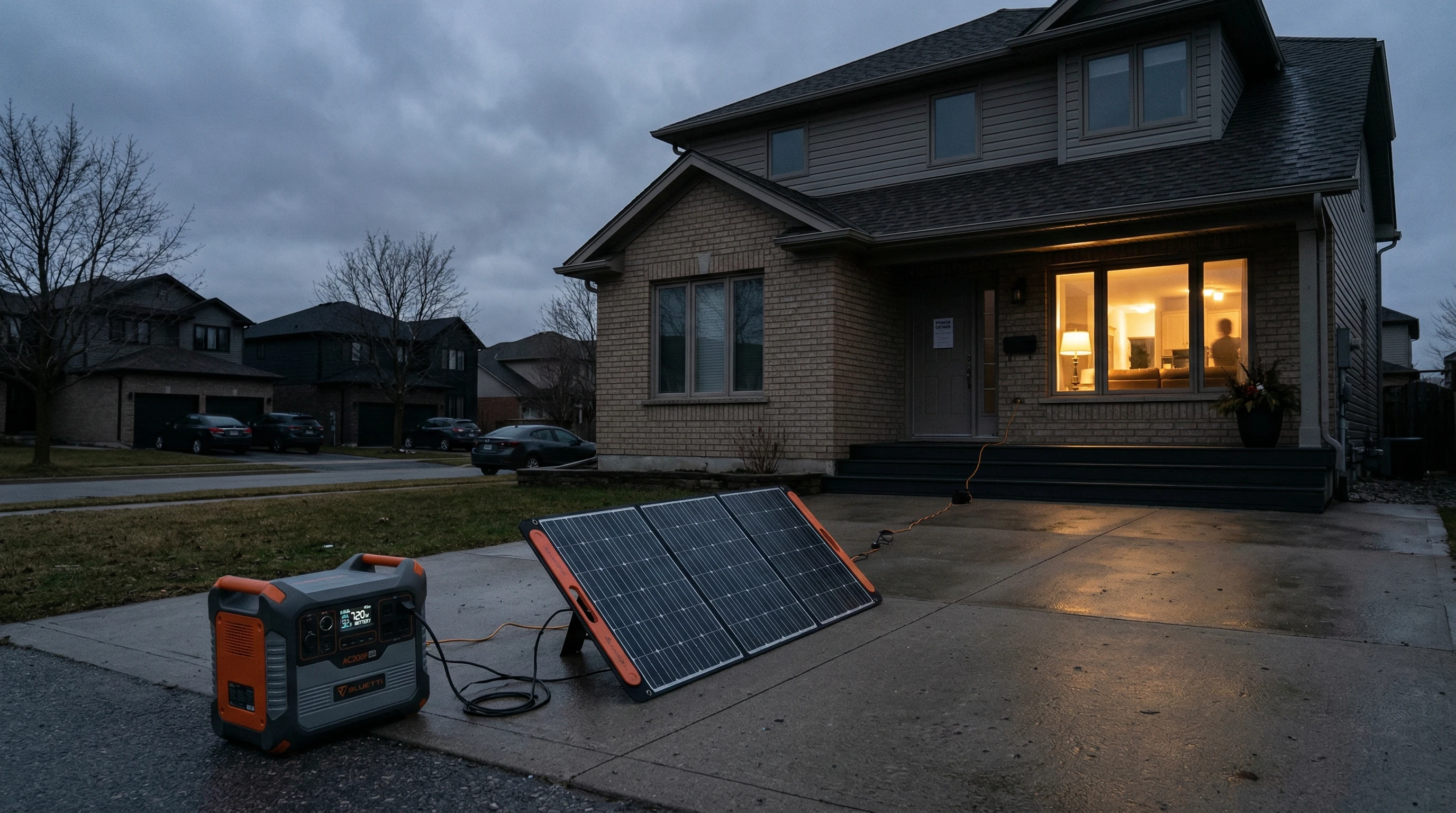
Solar Generators Covered in This Guide
High-Capacity Expandable Option: EcoFlow DELTA Pro
Expandable Backup Option: BLUETTI AC200MAX
Compact Backup Option: ALLPOWERS S1500
Portable 1kWh-Class Option: EcoFlow DELTA 2
Current 1kWh-Class Option: Jackery Explorer 1000 v2
Some of these models are now older-generation or have limited availability. The individual sections below explain their current status and specifications so you can compare them with newer alternatives before purchasing.
Why Solar Generators Can Be Useful During Power Outages
Battery-based solar generators can provide backup power without burning fuel at the point of use. This makes them fundamentally different from gasoline, propane or diesel generators, which produce combustion exhaust and must be operated outdoors according to manufacturer safety instructions.
Portable power stations can generally be recharged from a wall outlet before an outage, and compatible models may also support solar or vehicle charging. During a longer outage, solar panels can help replenish some of the energy being consumed, although actual charging depends on weather, sunlight, panel size and the system’s input limits.
Other practical advantages include relatively quiet operation and the ability to power selected electronics without storing fuel.
- No fuel combustion: Battery operation does not produce combustion exhaust at the point of use.
- Relatively quiet operation: Cooling fans may run, but battery systems are generally much quieter than fuel generators.
- Multiple charging options: Depending on the model, charging may be available from AC power, solar panels or a vehicle.
- Portable backup: Suitable systems can provide temporary power for selected household essentials.
How to Choose a Solar Generator for Emergencies
Solar generators vary considerably in battery capacity, inverter output, recharge capability and expandability. For emergency backup, start by identifying the devices you need to power and estimating their energy requirements.
- Battery capacity (Wh): Indicates how much energy the battery stores. Required capacity depends on the devices being powered and how long they need to operate.
- Output power (W): Check continuous inverter output and surge capability against the requirements of connected appliances, especially equipment with motors or compressors.
- Recharge options: Compare AC charging, compatible solar input, vehicle charging where supported, and the manufacturer’s maximum input specifications.
- Expandability: Some systems support compatible additional battery modules, allowing stored energy capacity to be increased. Solar expansion remains subject to the system’s voltage, current and maximum input specifications.
- Connections: Check that the system provides the AC, USB and DC outputs required by the devices you intend to use.
Solar Generator Comparison Table
| Model | Battery Capacity | Rated AC Output | Best For / Status |
|---|---|---|---|
| EcoFlow DELTA Pro | 3,600Wh | 3,600W | High-capacity expandable backup; older generation |
| BLUETTI AC200MAX | 2,048Wh | 2,200W | Expandable backup; discontinued by BLUETTI UK |
| ALLPOWERS S1500 | 1,092Wh | 1,500W | Basic short-term backup; check current availability |
| EcoFlow DELTA 2 | 1,024Wh | 1,800W | Portable essential backup; older generation |
| Jackery Explorer 1000 v2 | 1,070Wh | 1,500W | Current compact essential-backup option |
👉 Compare the best solar generators here and find the right backup for your home
Solar Generators to Consider for Power Outages
EcoFlow Delta Pro
The EcoFlow DELTA Pro is a high-capacity portable power station built around a 3,600Wh LFP battery and a 3,600W AC output, with a surge rating of up to 7,200W. This gives it considerably more capacity and output than smaller portable units, although appliance compatibility should still be checked against continuous and startup power requirements.
The system supports additional battery capacity and solar charging, with up to 1,600W of solar input supported by the DELTA Pro. Wi-Fi and Bluetooth connectivity also allow compatible monitoring and control through the EcoFlow app.
EcoFlow lists an AC recharge time of approximately 1.9 hours for the international version under specified charging conditions. Charging performance can vary by region, power source and setup, so current manufacturer specifications should be checked before purchase.
The original DELTA Pro is now an older model and EcoFlow UK currently directs buyers toward newer DELTA Pro models. Availability may therefore depend on region and remaining retailer stock.
👉 Check EcoFlow Delta Pro latest price and availability here
Bluetti AC200MAX
The BLUETTI AC200MAX is an expandable portable power station with a 2,048Wh LiFePO₄ battery and 2,200W pure sine wave AC inverter, with a surge rating of up to 4,800W. Its combination of battery capacity and inverter output makes it suitable for supporting selected household essentials during an outage, provided appliance requirements remain within the system’s limits.
The AC200MAX supports up to 900W of solar input and can be expanded with compatible BLUETTI battery modules. With two B230 batteries, total capacity can reach 6,144Wh, while two B300 batteries can increase total capacity to 8,192Wh. It also provides multiple AC, USB and DC outputs, along with wireless charging and app-based monitoring.
Charging time depends on the power source and configuration. BLUETTI lists approximately 5.5–6 hours using the standard 400W AC adapter, while combined AC and solar charging can reduce this under suitable conditions.
The AC200MAX has now been discontinued by BLUETTI UK, so new-unit availability may be limited and buyers should compare it with current BLUETTI alternatives before purchasing.
👉 See Bluetti AC200MAX current price and options here
ALLPOWERS S1500
The ALLPOWERS S1500 is a more compact backup option with a 1,092Wh battery capacity and 1,500W pure sine wave AC output, with up to 3,000W surge capability. This capacity is better suited to selected essential loads than whole-home backup, and actual runtime depends on the appliances being powered and their energy consumption.
The original S1500 supports multiple charging methods, including AC, solar and vehicle charging. ALLPOWERS currently also lists the newer S1500 Plus in the UK, which retains the 1,092Wh capacity and 1,500W rated AC output while offering faster charging and up to 650W of solar input.
Availability should be checked before purchase. At the time of this update, the S1500 Plus is listed by ALLPOWERS UK but is currently out of stock, while the company also offers newer alternatives in the same general portable-power category.
👉 Check ALLPOWERS S1500 current price and availability
EcoFlow Delta 2
The EcoFlow DELTA 2 is a compact portable power station with a 1,024Wh LFP battery and 1,800W AC output, with a surge rating of up to 2,700W. Its combination of capacity, output and portability makes it better suited to selected essential devices and shorter backup scenarios than high-capacity whole-home applications.
The DELTA 2 supports up to 500W of solar input and can be expanded with a compatible DELTA 2 or DELTA Max extra battery. Wi-Fi and Bluetooth connectivity also provide access to monitoring and charging settings through the EcoFlow app.
For outage planning, appliance compatibility should be checked against both the system’s continuous output and surge capability, while expected runtime should be estimated from usable battery capacity and actual energy consumption.
EcoFlow UK currently lists the DELTA 2 as sold out, while the newer DELTA 3 Series occupies a similar capacity and output category. Buyers should therefore compare current availability and specifications before choosing between generations.
👉 Check EcoFlow DELTA 2 current availability and alternatives
Jackery Explorer 1000
The Jackery Explorer 1000 v2 is a compact 1kWh-class portable power station designed for portable use and short-term emergency backup. It provides 1,070Wh of battery capacity with a 1,500W rated AC output and up to 3,000W surge capability, making it suitable for selected household essentials when their power requirements remain within the system’s limits.
The updated model uses LiFePO₄ battery chemistry and supports up to 400W of solar input. It also includes app-based monitoring and a UPS function with a transfer time of up to 20ms. Jackery lists standard AC charging at approximately two hours, while its optional Emergency Charge mode can reduce this to around one hour under specified conditions.
For outage use, expected runtime should be calculated from the devices being powered rather than assumed from battery capacity alone. Refrigerators and other appliances with compressors also require their startup power to be checked against the inverter’s surge capability.
Compared with the original Explorer 1000, the v2 provides higher output, updated LiFePO₄ battery chemistry and substantially faster charging, making it the more relevant version to consider for a current emergency-backup guide.
👉 Check Jackery Explorer 1000 v2 current price and availability
What Can You Power During a Blackout?
What a solar generator can power depends on both its battery capacity and inverter output. Lower-power devices are generally easier to support during an outage, while appliances with heating elements, motors or compressors require more careful planning.
Common backup priorities may include:
- Refrigeration
- LED lighting
- Router and modem
- Phones, tablets and laptops
- Fans and other selected low-power devices
Refrigerators and other compressor-based appliances require particular attention because startup power can be higher than normal running power. High-power appliances such as microwaves, electric heaters and some power tools may also consume stored energy quickly.
Check each appliance’s specifications and compare its running power, startup requirements and expected energy consumption with the power station’s limits.
Not sure how much backup energy your essential devices may need? The Home Power Outage Planner & Runtime Toolkit can help you list your essential loads and compare your battery capacity with estimated 24, 48 and 72-hour outage needs.
How Long Will a Solar Generator Last During an Outage?
Runtime depends on usable battery energy and the average load connected to the system. A simple starting estimate is:
Estimated Runtime (hours) = Usable Battery Energy (Wh) ÷ Average Load (W)
This calculation is only an estimate. Inverter losses, standby consumption, battery condition, temperature, appliance cycling and incoming solar energy can all affect actual runtime.
A larger battery generally provides more available energy, but selecting a system based only on advertised Wh capacity can be misleading. Consider both usable energy and the power requirements of the devices you intend to run.
For a deeper explanation, see How Long Can a Solar Generator Power a House?
Solar Generator vs Gas Generator: Which Works Best for Outages?
Battery-based solar generators and fuel generators have different strengths.
Portable power stations operate quietly and do not produce combustion exhaust at the point of use. They can be practical for selected essential devices, particularly when fuel storage or generator noise is undesirable. Their runtime, however, is limited by stored battery energy and available recharge options.
Fuel generators can provide substantial continuous power as long as suitable fuel remains available, but they produce carbon monoxide and other combustion exhaust. They must be operated outdoors and positioned according to manufacturer instructions, away from doors, windows, vents and other openings.
Neither option is automatically better for every household. The appropriate backup system depends on required loads, outage duration, location, fuel availability, recharge options and safety requirements.
Need Extra Backup?
Permanently installed home battery systems can provide greater backup capacity and may be integrated with selected household circuits or whole-home electrical systems. System capability depends on battery capacity, inverter output, installation design and the loads being supported.
👉 Read my full Solar Generator vs Home Battery System comparison here
Plan Your Emergency Backup Before You Buy
Choosing a solar generator is easier when you know how much energy your essential devices may actually require.
The Ecowised Home Power Outage Planner & Runtime Toolkit includes a printable planning guide and Excel runtime calculator to help you list essential devices, estimate energy needs, and compare available battery capacity with 24, 48 and 72-hour outage scenarios.
Get the Home Power Outage Planner & Runtime Toolkit — £8.99
Frequently Asked Questions About Solar Generators for Power Outages
What size solar generator is best for a power outage?
The right size depends on the devices you need to power, their energy consumption and how long you expect the outage to last. Start by listing your essential devices and estimating their daily energy use in watt-hours (Wh). Then compare that requirement with the power station’s usable battery capacity, continuous inverter output and surge capability. Refrigerators, pumps and other appliances with motors may also require additional startup power.
How long will a solar generator run during an outage?
Runtime depends on usable battery capacity and the average power draw of connected devices. A simple starting estimate is to divide usable battery energy in watt-hours (Wh) by the average load in watts (W). Actual runtime can vary because of inverter losses, standby consumption, battery condition, temperature, appliance cycling and incoming solar energy.
Can a solar generator run a refrigerator during a blackout?
A suitably sized solar generator may be able to power a refrigerator during an outage. Check the refrigerator’s running power, startup surge and energy consumption against the power station’s inverter rating and usable battery capacity. Refrigerator compressors cycle on and off, so daily energy consumption is generally more useful for estimating backup needs than running wattage alone.
Do you need solar panels to use a solar generator during an outage?
No. Most portable power stations can be charged from a wall outlet before an outage and then used from their stored battery energy. Compatible solar panels can provide another charging option when grid power is unavailable. Actual solar charging performance depends on sunlight, weather, shading, panel orientation, system efficiency and the power station’s solar input limits.
Can a solar generator be used indoors?
Battery-based portable power stations do not burn gasoline, propane or diesel during normal operation and therefore do not produce combustion exhaust like fuel generators. However, they should still be operated and stored according to the manufacturer’s instructions, including requirements for ventilation, temperature, moisture, clearance and charging. Fuel-powered generators must never be operated indoors or in enclosed spaces because of carbon monoxide risk.
Is a solar generator better than a gas generator for emergencies?
Neither option is automatically better for every outage. Battery-based solar generators are relatively quiet, do not require fuel combustion during operation and can be convenient for selected essential devices. Fuel generators can provide substantial continuous power while fuel is available, but they produce carbon monoxide and other combustion exhaust and must be operated outdoors according to manufacturer safety instructions. The better choice depends on required loads, outage duration, location, recharge options, fuel availability and safety requirements.
Final Thoughts
The best solar generator for a power outage is not necessarily the model with the largest battery. It is the system that can safely support your essential devices, provide enough usable energy for the expected outage duration, and offer practical recharge options.
Before choosing a system, estimate your essential loads and compare them with battery capacity, continuous inverter output, surge capability and charging specifications. For longer outages, also consider how the system will be recharged if grid power remains unavailable.
Careful sizing before an emergency provides a more reliable backup plan than choosing a system based on capacity or marketing claims alone.