
Some of the links on this page are affiliate links, which means I may earn a small commission if you make a purchase through them, at no extra cost to you. This helps support the site and allows me to continue creating helpful content.
If you’re relying on a portable power station to keep devices running during an outage or off-grid trip, knowing how long your battery will last is really important. Calculating runtime with multiple devices can feel confusing at first, but you can figure it out with a straightforward method. Basically, you need to work out the total energy your devices will use (measured in watt-hours), check the usable energy your power station provides, and do some simple math.
Quick Answer
To estimate power station runtime for multiple devices, calculate how much energy each device will use, add those energy requirements together, and compare the total with the power station’s usable battery capacity.
- Energy Use (Wh) = Power (W) × Time (hours)
- Estimated Runtime (hours) = Usable Battery Energy (Wh) ÷ Average Load (W)
These formulas provide an estimate rather than a guaranteed runtime because conversion losses, standby consumption and changing device loads can affect the result.
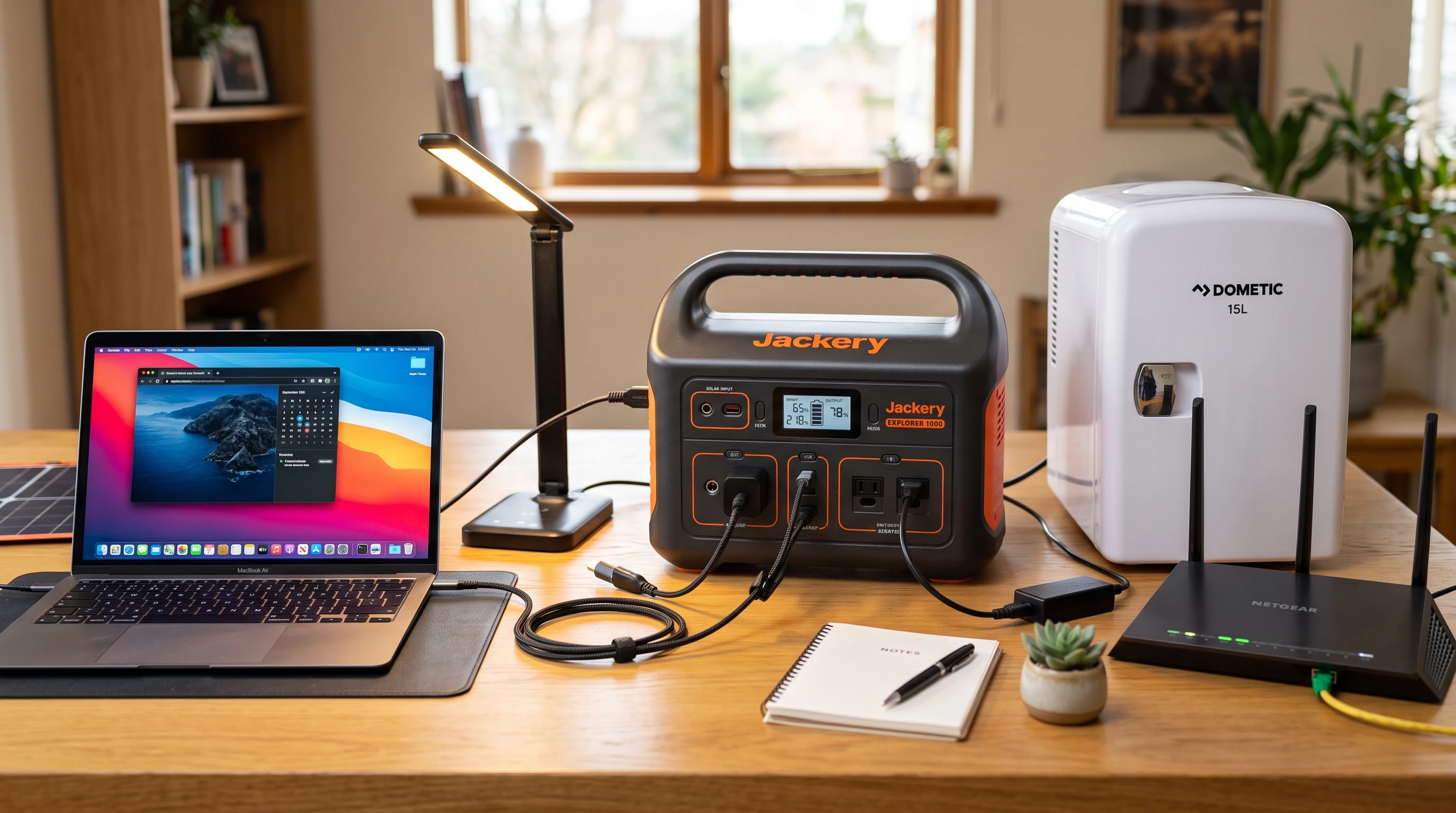
Watts vs Watt-Hours
It’s easy to mix up watts (W) and watt-hours (Wh), but there’s a big difference. Watts describe how quickly your device uses power, while watt-hours measure the total energy used over a length of time.
For example, if you have an LED lamp that uses 10 watts, and you run it for three hours, you’ll use:
10W × 3 hours = 30Wh.
List the Devices You Need During an Outage
You may only need a few essential devices during an outage, while other households may need to support a larger number of loads. Making a checklist helps identify what should receive priority if stored energy is limited.
- Refrigerator (to keep food from spoiling)
- Router/modem (for internet access)
- LED lights (for basic visibility)
- Laptop (work, school, or entertainment)
- Phone (charging for communication)
- Fan (for air circulation)
Every home is different. Walk from room to room and write down every device you want to run.
Calculate Energy Use for Multiple Devices
Each device’s wattage is usually printed on a label, power brick, or in its manual. You can also check the manufacturer’s website. Once you know the wattage, estimate how long you’ll be using each device per day.
For each device, use:
Energy Use (Wh) = Power (W) × Operating Time (hours)
For example, a device drawing 20W for three hours would use approximately:
20W × 3 hours = 60Wh
Repeat the calculation for each device and add the results together to estimate total energy demand.
Remember, appliances like fridges or air conditioners don’t draw full wattage all the time; they cycle on and off. For a more realistic estimate, look for average energy consumption data from the manufacturer or measure consumption with a suitable plug-in energy meter.
Battery Capacity, Efficiency and Surge Power
Most battery manufacturers list the capacity in Wh, but the usable amount is sometimes less because of built-in safety margins. Also, some energy is lost due to the inverter (which converts DC to AC), and your power station may use a small amount just to stay powered up.
Key details:
- Usable Capacity: The energy available to connected devices may be lower than the advertised battery capacity because of system limits, reserve settings and conversion losses.
- Inverter Losses: Converting stored DC energy into AC power introduces losses, so the battery’s advertised capacity should not automatically be treated as energy available at the AC outlets.
- Standby Consumption: Power stations use a trickle of power even when not directly powering a device.
- Continuous vs Surge Output: Some appliances require a brief increase in power during startup. Check that both the continuous and surge output ratings of the power station are compatible with the connected equipment.
Every power station is unique, so check your model’s details for accurate numbers.
How Solar Charging Changes Runtime
Many modern power stations let you hook up portable solar panels. While this can add to your available energy, it’s not the same as having unlimited power. The added charge depends on your panel’s wattage, how it’s set up, the weather, and hours of good daylight.
Actual solar energy production can vary substantially with weather, season, shading, panel orientation, temperature and available daylight. A panel’s advertised wattage represents its rated output under specified conditions rather than guaranteed real-world production.
Also check the power station’s supported solar voltage, current and maximum input before connecting panels.
Planning for 24, 48 and 72-Hour Outages
When a blackout stretches from one day to more, strategic planning matters. List out your must-have devices versus items you can skip. Focus first on the devices that are most important for your household, such as communication equipment, basic lighting, internet access and refrigeration. You can leave out non-essentials like gaming consoles or big TVs if your battery is limited.
Once you have estimated one day of energy consumption, you can use it as a starting point for longer outage scenarios. For example, a similar usage pattern over two or three days would require roughly two or three times the daily energy before accounting for any recharging.
If your power station can’t meet all your needs, trim your device list, reduce operating hours, or consider a model with more battery capacity or additional solar panels.
Calculate Your Own Backup Plan
If you want an easy way to check your home’s device needs and power station runtime, the Ecowised Home Power Outage Planner & Runtime Toolkit can help. You can enter your device names, their wattages, and how many hours you’ll run each. The toolkit helps estimate energy needs for 24, 48 and 72-hour outage scenarios and makes it easier to compare different usage plans.
Get the Home Power Outage Planner & Runtime Toolkit — £8.99
Common Runtime Calculation Mistakes
- Mixing up watts and watt-hours: Watts measure power, while watt-hours measure energy consumed over time. Always use the right values in your calculations.
- Ignoring inverter losses: Advertised battery capacity does not necessarily equal the energy available to connected AC devices. Look for the “usable capacity” or check the manual for how much energy is lost in the conversion process.
- Overlooking device cycling: Many appliances (like fridges, pumps) use power only some of the time. Use average daily use, not rated power times 24 hours—unless they run continuously.
- Forgetting standby and phantom loads: Plugged-in but unused devices, or the station itself, still draw energy. Remember to include these in your estimate.
- Overestimating solar input: Panel output depends on sunlight, tilt, temperature, and season. Use average production numbers, not just the label rating, especially in cloudy weather or winter.
Related Guides
- How Long Will a Solar Generator Last During a Power Outage?
- Portable Power Station Wattage Explained
- What Can You Run on a Portable Power Station?
- How to Recharge a Solar Generator During a Power Outage
- Best Solar Generators for Home Backup
FAQ
How do I calculate how long my power station will run multiple devices?
Calculate the energy requirement of each device separately by multiplying its power in watts by its expected operating time in hours. Add the resulting watt-hours together and compare the total with the power station’s usable battery energy. Actual runtime may vary because of conversion losses and changing loads.
What’s the difference between watts (W) and watt-hours (Wh)?
Watts measure power at a particular moment, while watt-hours measure energy consumed over time. For example, a 100W device operating continuously for 10 hours would consume 1,000Wh of energy.
Do I need to account for inverter or conversion losses?
Yes. Converting stored battery energy into usable AC power introduces losses, so advertised battery capacity does not necessarily equal the energy delivered to connected AC devices. Check the manufacturer’s specifications when available rather than assuming a universal efficiency percentage.
Do all devices run at their maximum wattage the whole time?
No. Some appliances cycle on and off or change their power consumption during operation. Refrigerators are a common example. Manufacturer energy data or measured consumption can provide a more useful estimate than assuming maximum rated power continuously.
Can solar panels extend power station runtime?
Yes. Compatible solar panels can replenish some of the energy consumed during an outage. Actual production depends on sunlight, weather, season, shading, panel orientation and the power station’s solar input limits, so solar charging should not be treated as guaranteed or unlimited power.
Why does my power station run for less time than a simple calculation suggests?
Simple runtime calculations may not account for inverter losses, standby consumption, changing appliance loads or reserve capacity. Manufacturer runtime examples may also use different loads and test conditions from your own setup.
Final Takeaway
Calculating power station runtime for multiple devices starts with understanding the energy requirements of your own equipment. Estimate the watt-hours each device will consume, combine those requirements and compare the result with the power station’s usable battery capacity.
Account for conversion losses, changing loads, startup requirements and realistic solar charging where applicable. This provides a more useful backup estimate than relying on generic manufacturer runtime claims.