
Power outages can leave homeowners wondering how long a solar generator can realistically keep essential devices running. The answer depends less on the size of the house itself and more on battery capacity, the appliances being powered, their energy use, inverter limits, and whether the system can recharge during the outage.
A portable solar generator may keep selected essentials such as a refrigerator, lights, router and communication devices operating for hours or potentially longer, while high-power appliances can drain the same battery much faster.
This guide explains how solar generator runtime works, how to estimate your own backup needs, and what to expect from different battery capacities during a power outage.
Quick Answer: How Long Can a Solar Generator Power a House?
There is no single runtime for a solar generator. A 2,000Wh system might run a modest collection of essential devices for many hours, but actual runtime depends on usable battery capacity and total energy consumption. Refrigerators also cycle on and off, while heaters, kettles, microwaves and other high-power appliances can use energy much faster.
A useful starting estimate is:
Estimated Runtime (hours) = Usable Battery Energy (Wh) ÷ Average Load (W)
This is only an estimate. Inverter losses, standby consumption, battery condition, temperature, appliance cycling and solar recharging can all change real-world runtime.
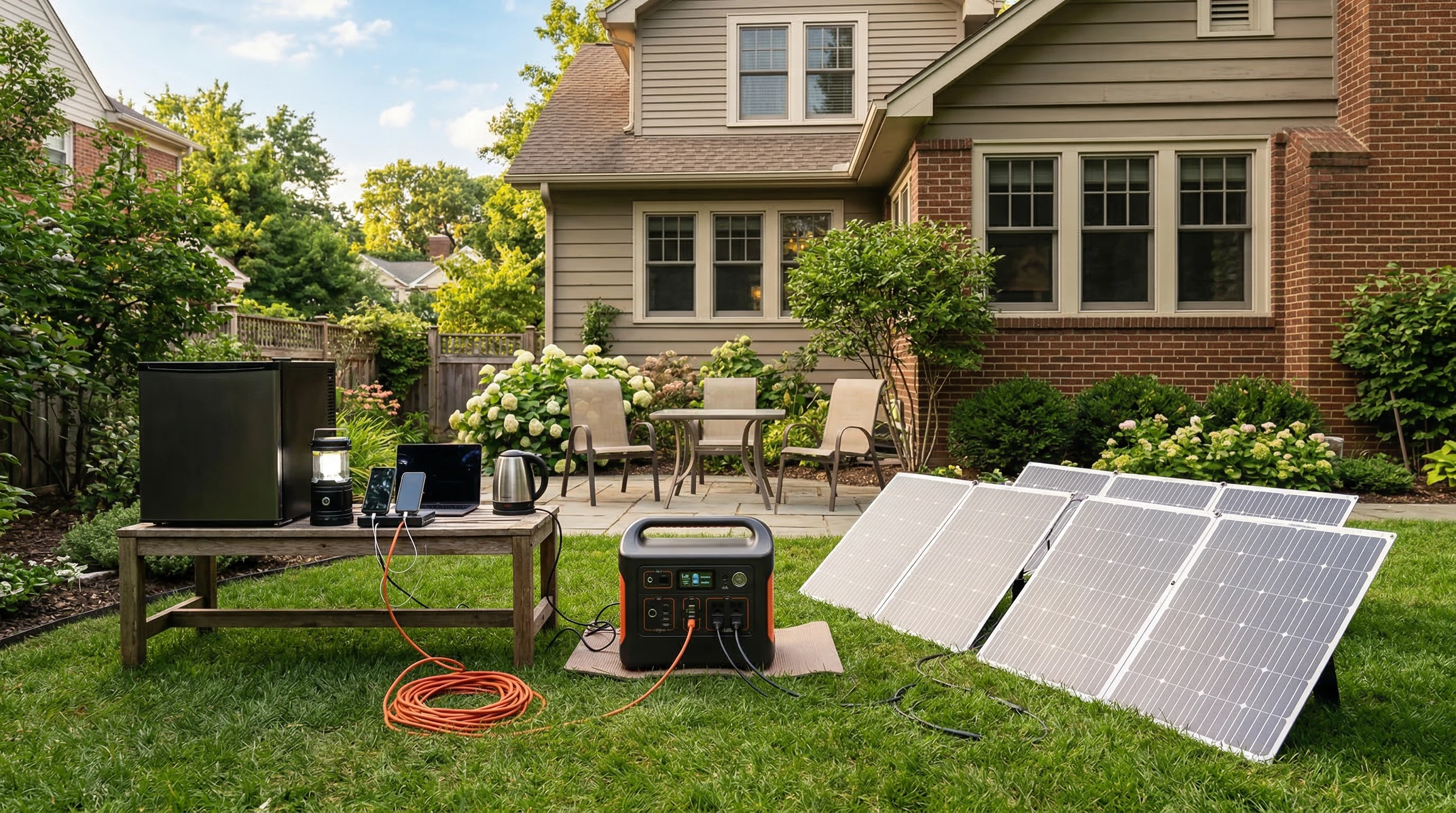
What Determines How Long A Solar Generator Can Power A House
Solar generator runtime depends on several connected factors. The first is battery capacity, measured in watt-hours (Wh), which indicates how much energy the battery can store.
Appliance power draw is just as important. Each device in your home uses power at a different rate, measured in watts (W). If you run an appliance that pulls a lot of power, like a microwave or heater, it’ll drain the battery a lot faster than a small device, like a lamp or laptop charger.
Every solar generator has an inverter, which handles the conversion from battery (DC) power to household (AC) power. The inverter has a maximum output, usually labeled as “continuous output” (the safe, steady power it can supply) along with a “peak” rating (for short surges, like when you first start a fridge or microwave). If your appliances try to pull more power than the inverter can handle, you’ll trip the system or the inverter will shut down to protect itself.
Solar panel input also makes a difference. Some generators allow you to add solar panels to recharge the battery while you use it. During daylight hours, solar input may extend runtime or replace part of the energy being consumed. Whether the battery gains or loses charge depends on actual solar input compared with the energy being used by connected devices. At night, you’ll rely entirely on the battery.
Here’s a summary of the key variables you’ll need to pay attention to:
- Battery capacity (watt hours): The bigger, the longer it can run things.
- Appliance power draw (watts): Higher watt devices use more energy faster.
- Inverter output (watts): Sets a limit on how many devices you can run at once.
- Solar panel input (watts): Adds extra energy during daylight to keep things running.
It’s important to also consider the age and temperature of your battery. Older batteries, or those used in really cold or really hot weather, might provide less usable energy per charge. Always check your system’s specifications for temperature ranges and cycles to set realistic expectations.
Typical Power Consumption In A Home
Estimating runtime starts with understanding how much power your essential devices use. The figures below are general examples only; actual consumption varies significantly by model, operating mode and usage. When possible, check the appliance label, manufacturer specifications or measured energy consumption rather than relying only on generic estimates.
- Refrigerator: 120 to 200 watts (average running)
- LED lights (per bulb): 8 to 15 watts
- WiFi router: 8 to 15 watts
- Laptop: 40 to 70 watts while charging
- TV (LED, 40-55”): 60 to 150 watts
- Microwave: 900 to 1,500 watts (while running)
- Electric heater (small space unit): 1,000 to 1,500 watts
Smaller devices such as phone and tablet chargers generally use much less power than high-draw appliances. Electric heaters, microwaves and other devices that produce significant heat can consume stored energy much faster, while lighting, communication equipment and small electronics are typically easier to support with limited backup capacity.
Refrigerators require special attention because their compressors cycle on and off rather than drawing their rated running power continuously. Daily energy consumption therefore provides a more useful basis for backup planning than simply multiplying the running wattage by 24 hours. Startup surge requirements should also be checked against the power station’s inverter specifications.
Estimated Runtime (hours) = Usable Battery Energy (Wh) ÷ Average Load (W)
For example, if a system provides approximately 1,700Wh of usable energy and the average connected load is 200W:
1,700Wh ÷ 200W = approximately 8.5 hours
Real-world runtime may be shorter or longer depending on inverter losses, battery condition, temperature, appliance cycling, standby consumption and incoming solar energy.
Want to calculate this using your own appliances? The Home Power Outage Planner & Runtime Toolkit lets you enter your essential devices, battery capacity and expected usage to plan for 24, 48 and 72-hour outage scenarios.
Example Runtime Scenarios
Here’s how the most common solar generator sizes stack up for basic home backup:
- Around 1,000Wh: Better suited to selected low-energy essentials such as lights, phones, a router and laptops. Refrigerator runtime varies considerably by model, ambient temperature and compressor cycling.
- Around 2,000Wh: Provides more flexibility for combining several essential devices and may support refrigeration alongside communications, lighting and electronics, provided total energy use and inverter limits are carefully managed.
- Around 3,000Wh: Offers additional stored energy for longer outages or a broader group of essential loads. Actual runtime still depends on daily energy consumption rather than battery capacity alone.
- Around 5,000Wh and above: Larger systems may support more devices or longer backup periods, especially when paired with suitable recharging. They should not automatically be treated as whole-home systems; high-power heating, cooling, cooking equipment, pumps and other large loads require individual sizing and compatibility checks.
If you’re hoping to use your generator for hobbies, power tools, or pumping water from a well, include those watt numbers in your planning too. The same principles apply—figure out what draws the most power, and you’ll know how long you can get by.
Running Essential Appliances During A Power Outage
During an outage, backup power usually lasts much longer when only essential loads are prioritized. Common priorities may include refrigeration, basic lighting, communication equipment and device charging.
High-energy loads such as electric heating, central air conditioning, electric ovens and laundry equipment can consume stored energy much faster. Creating an essential-load list before an outage makes it easier to decide what should receive backup power and what can remain switched off.
Remember to write down a quick plan or checklist ahead of time. In a power loss, you can act fast, plug in only what you need, and avoid draining valuable battery capacity on less important devices.
Can A Solar Generator Power An Entire House?
Most portable solar generators cannot power an entire house at once. Instead, they are designed to support essential appliances such as refrigerators, lights, communication devices, and small electronics. Running heavy loads like central air conditioning or electric heating requires much larger home battery systems.
Solar Panel Recharging And Extending Runtime
Adding solar panels to your generator opens up some nice options to go beyond just what’s in the battery. When the sun’s out, your solar panels can recharge the generator during the day even as you use it. Depending on the size of your panel array (rated in watts), you might be able to gain several hundred to over a thousand watt hours of power on a clear day.
For example, a solar array rated at 400W will not necessarily deliver 400W continuously. Actual charging depends on sunlight intensity, panel angle, shading, temperature, weather, system efficiency and the power station’s solar input limits. The energy collected during a day can therefore vary substantially.
When planning for a multi-day outage, compare expected daily energy consumption with realistic daily recharge potential rather than assuming the panel’s rated wattage will be available continuously.
Good solar conditions can significantly extend backup duration, but multi-day operation depends on whether daily energy input is sufficient to replace the energy being consumed.
Solar production is generally lower in cloudy conditions and can vary substantially throughout the day. Panel orientation, shading, weather and system input limits should all be considered when estimating recharge potential. Follow the panel and power station manufacturers’ guidance for positioning, compatibility and operating conditions.
Realistic Expectations For Whole-Home Backup
Most of the portable solar generators you see advertised for home backup are generally better suited to essential or partial backup, not for powering an entire central air system, multiple freezers, or electric stoves all at once. Whole home backup systems do exist, but those require much larger and more expensive setups, including sizable battery banks, dedicated inverter panels, and a rooftop full of solar panels. Those systems are a bigger investment and much more involved to set up.
For many households, portable backup power is more practical for selected essentials such as refrigeration, communication, lighting and low-power electronics than for high-energy whole-home loads. Attempting to run multiple high-power household loads can reduce battery runtime dramatically and may also exceed the system’s continuous or surge output limits.
Some people pair smaller, portable solar generators with fuel generators for backup, or invest in “hybrid” systems that can switch between solar, battery, and grid power as needed. The appropriate approach depends on the required loads, expected outage duration, available recharge options and the electrical requirements of the equipment being powered.
Tips To Maximize Solar Generator Runtime
These steps can help reduce unnecessary energy use and extend available backup runtime:
- Unplug appliances you’re not using. “Phantom” draws can add up over hours or days.
- Use LED bulbs instead of incandescent ones. They use far less energy for the same brightness.
- Open the fridge or freezer as little as possible. Each time it’s opened, the compressor has to run to cool it back down.
- Charge all devices during daylight hours while the generator is also getting a solar charge.
- Bundle up with clothing and blankets instead of trying to heat a whole room with electric heaters.
- If it’s safe, run high draw devices one at a time to avoid overloading the inverter and draining the battery too fast.
- Keep phone and laptop screens dimmed, and put devices into low power modes whenever possible.
Planning and a little discipline make a huge difference in how long a solar generator will keep you comfortable during an extended outage.
If you have kids or guests at home, it helps to teach everyone the basics of energy use—like keeping fridge doors shut and using just one light if possible. Every small habit counts when you’re stretching backup power for days.
Choosing a Solar Generator for Home Backup
When comparing solar generators for outage backup, focus first on the electrical requirements rather than the brand name.
Important specifications include battery capacity in Wh, estimated usable energy, continuous inverter output, surge capability, solar input limits, recharge options, battery chemistry, expandability and manufacturer operating restrictions.
A larger battery does not automatically make a system suitable for every appliance. Check both energy capacity and power requirements, especially for refrigerators, pumps and other devices with startup surges.
Expandable systems can be useful when backup needs may grow over time, but additional batteries and solar panels must be compatible with the specific power station.
For current product comparisons, see our Best Solar Generators for Home Backup guide.
Plan Your Backup Runtime Before the Next Outage
Knowing your battery capacity is only half of the calculation. Your actual backup needs depend on which devices you plan to run, how long they operate, and how much energy they use.
The Ecowised Home Power Outage Planner & Runtime Toolkit includes a printable planning guide and Excel runtime calculator to help you list essential devices, estimate energy needs, and compare your available battery capacity with 24, 48 and 72-hour outage scenarios.
Get the Home Power Outage Planner & Runtime Toolkit — £8.99
Frequently Asked Questions About Solar Generator Runtime
How do I calculate how long a solar generator will last?
Start by estimating the usable battery energy in watt-hours (Wh) and the average power draw of the devices you want to run in watts (W). A simple starting formula is:
Estimated Runtime (hours) = Usable Battery Energy (Wh) ÷ Average Load (W)
For example, 1,700Wh of usable energy supplying an average 200W load would provide an estimated 8.5 hours of runtime. Actual results can vary because of inverter losses, standby consumption, battery condition, temperature, appliance cycling and incoming solar energy.
How long will a 2,000Wh solar generator run during a power outage?
There is no fixed runtime for a 2,000Wh solar generator because the result depends on the connected devices and how often they operate. Low-power essentials such as lights, routers and device chargers consume much less energy than electric heaters, microwaves or other high-power appliances. The battery’s usable energy may also be lower than its advertised capacity, so calculate your expected loads rather than relying on a single runtime estimate.
Can a solar generator run a refrigerator overnight?
A suitably sized solar generator may be able to run a refrigerator overnight, but runtime depends on the refrigerator’s energy consumption, compressor cycling, startup surge and the power station’s usable battery capacity and inverter rating. Check the refrigerator’s specifications or measured energy use and make sure both its running and startup requirements are compatible with the solar generator.
What size solar generator do I need for home backup?
The right size depends on which devices you want to power, their energy consumption, how long you need them to operate and whether you can recharge the battery during the outage. Add up the expected energy use of your essential devices, include a reasonable allowance for system losses, and then compare the result with the power station’s usable battery capacity, continuous output and surge rating.
Can solar panels keep a solar generator running during a long outage?
Solar panels can extend runtime by replacing some or all of the energy being consumed, but they do not guarantee continuous operation. Actual solar production depends on panel size, sunlight, weather, shading, temperature, panel orientation and the power station’s solar input limits. For multi-day backup, compare realistic daily solar production with expected daily energy consumption.
Can I use a solar generator while it is charging?
Many portable power stations support some form of simultaneous charging and discharging, sometimes called pass-through charging. However, capabilities and restrictions vary between models. Check the manufacturer’s instructions for supported charging methods, output limitations, operating temperatures and any restrictions that apply while the system is charging.
Wrapping Up
How long a solar generator can power a house depends on usable battery capacity, the devices being powered, their energy consumption, inverter limits and whether the system can recharge during the outage.
For most portable systems, planning around essential loads is more realistic than trying to power an entire home. Refrigeration, lighting, communication devices and small electronics may require relatively modest amounts of energy, while electric heating, air conditioning, cooking appliances and other high-power loads can reduce runtime quickly.
Before an outage, identify the devices you consider essential, estimate their daily energy use and compare that demand with your system’s usable battery capacity and recharge capability. This provides a much more realistic picture of backup runtime than relying on battery capacity alone.